Yet even with these issues, the game maintains a strong rating across platforms, often hovering around 4.2 to 4.3 out of 5. That suggests that for a large portion of its audience, the positives outweigh the negatives. The honesty, the tight loop, and the sheer novelty of playing “the ad game” as advertised create a bond with players that more polished but less transparent titles often fail to achieve.
A personal take: why I keep coming back
If I were to explain why I love this game in personal terms, it would come down to trust and flow. Trust, because Real War: Not Fake respects my time enough to tell me the truth upfront. I know what I’m downloading. I know what the loop is. I know where the ads are and what gems do. There’s no hidden agenda, no surprise pivot into a different genre after the tutorial. That transparency makes me more willing to tolerate its monetization quirks.
Flow, because when the ads aren’t interrupting, the game disappears into pure action. My thumb moves, the squad dodges, the gates flash, and the screen erupts in bullets. I’m not managing inventories or deciphering complex skill trees. I’m making rapid, intuitive choices and seeing immediate results. In a world of bloated live-service titles that demand daily check-ins and battle-pass grinding, there’s something almost meditative about a game that says: “Here’s a run. Do your best. Try again.”
I also appreciate the self-aware humor. The title itself is a punchline. The marketing leans into the joke. Even the upgrade descriptions feel like they’re winking at players who’ve been burned by similar systems before. It doesn’t take itself too seriously, and that lightness makes the frustrations easier to swallow. When an ad pops up, it’s annoying, but it doesn’t feel like a betrayal. It feels like part of the deal I signed up for when I downloaded a free game built around a meme.
In the end, Real War: Not Fake isn’t trying to redefine mobile gaming. It’s trying to be the honest version of a trope we all love to hate. For many players, including me, that’s enough. It’s a small, scrappy title that understands its audience and delivers a loop that feels good in the hands. The gems and ads are the price of admission, but the core experience—the dodge, the shoot, the gate choices, the boss fights—is worth it. And in a landscape full of fakes, there’s real value in a game that refuses to pretend to be anything other than what it is.
The Game I Was Promised: Why Real War: Not Fake Won Me Over
Every mobile gamer knows the ritual. You are halfway through a puzzle level or a round of something forgettable, and an ad fills the screen. A tiny squad of soldiers dashes down a road, shooting at glowing numbers. The gates multiply, the crowd grows, the explosions get bigger, and a boss appears at the end. You think, that looks like fun. You tap the install button, and what you download is a base-builder with timers, or a card game, or something that shares nothing with the footage that hooked you. You uninstall it in disgust, and the cycle repeats. I have done this more times than I want to admit, which is why Real War: Not Fake caught my attention.
The premise is almost cheeky. The game grew out of the frustration with a specific fake ad, the one for Last War Survival, which showed an on-rails shooter where you grow your squad by shooting numbers, and which featured an actor from The Boys. The actual game behind that ad, as many of us discovered, played nothing like it. Then one developer decided to fix that. The App Store description sums up the attitude in a single line: you were looking for the game, so I made it. I can't think of a better elevator pitch for a mobile title. It promises the thing you actually wanted, and then it delivers.
The developer goes by "The Greatest Developer," a tongue-in-cheek title that fits the game's humor. The store listing describes the studio as an indie French outfit called DEVDOP. Notebookcheck traced the game's debut to a YouTube video released on November 27, 2025, and noted that the creator had only two videos on the channel at the time. That origin story matters to me. This wasn't produced by a corporate committee with a monetization spreadsheet. It feels like one person who got as tired of misleading ads as the rest of us and did something about it. The rough edges show up in the updates and the personality, and honestly, I like them.
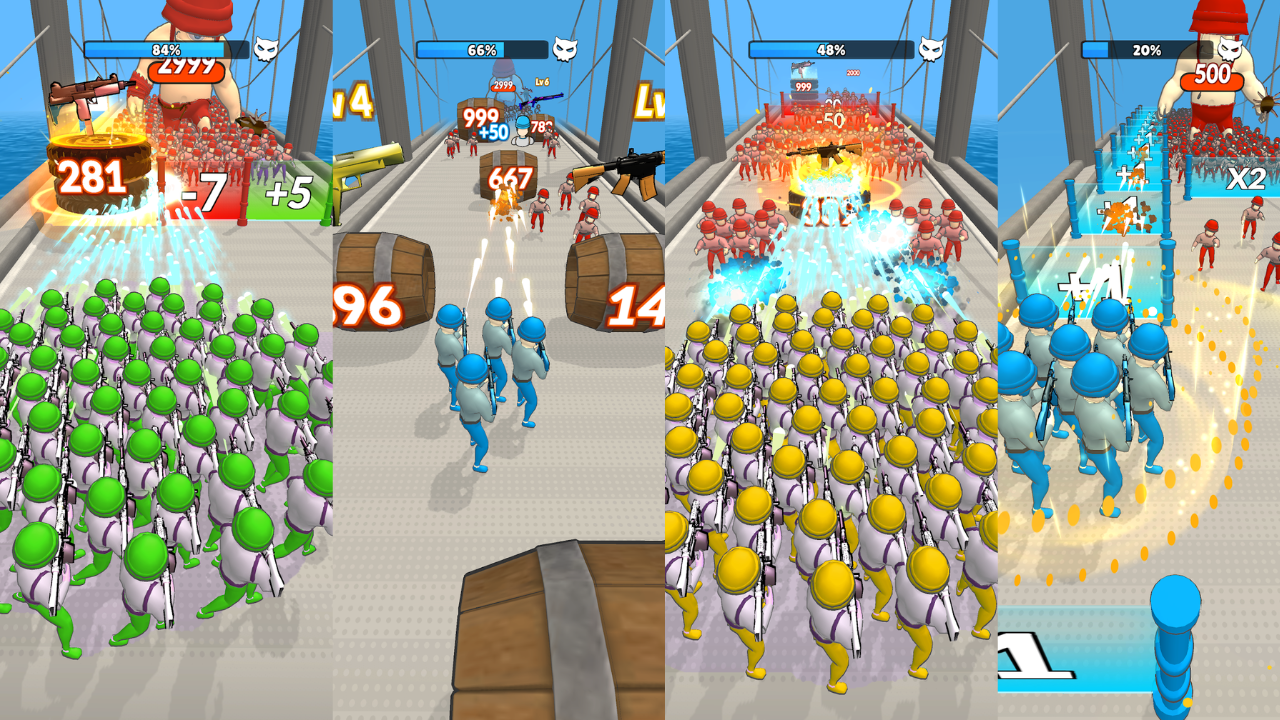
Then there's the gameplay, which is why I keep coming back. You slide left and right across the screen to dodge enemies and pick your path, while your weapons fire automatically. The real puzzle is the gates. You shoot thousands of bullets to raise the values on the bonus gates, and you beat the bosses to finish each level. The tension comes from deciding which lane to commit to. One gate might promise a larger army, another a stronger weapon, and a third some awkward barrel-filled detour. Half a second of hesitation and you've drifted into the wrong lane, and the whole run changes. It sounds shallow when I describe it, but the decisions come fast enough that I never feel like I'm just watching a screen.
What elevates it is how good it feels. The developer advertises vibration effects and a heavy dose of visual effects, and both are noticeable in play. Bullets snap out in bright streams, numbers climb with a satisfying rhythm, and the haptics give every big hit a little thud in your palm. Notebookcheck put it well when they described the appeal as watching numbers rise and big explosions light up the screen. That's the addictive core of the genre, and this game understands it better than most. It's the same pleasure as a slot machine or a popping bubble wrap, except that you're actually making choices along the way.
Now to the practical questions readers keep asking me, starting with the currency. Many mobile games run on gems or diamonds, a premium currency you buy with real money, but I couldn't find that in Real War. The store page advertises collecting coins for each victory, and coins are what you earn and spend. That is a refreshing change. There isn't a confusing web of two or three currencies to track, and I never had to work out an exchange rate to decide whether something was worth it. You win, you earn coins, and you spend them. It sounds trivial, but a single currency makes the whole economy easier to read, and it means I never feel that the game is quietly hiding its real prices behind a layer of shiny tokens.
So what do coins buy? The most important thing, for many players, is a break from the ads, which I'll come to below. Coins also feed the progression side of the game, and the bigger updates have widened that. Version 4.0 added skins, quests that pay out up to one million coins, multiplier gates, new levels with barrels and fresh bonuses, weapon balancing, a fix for damage per second, and more boss variety. That's a healthy amount of new content for an indie project, and it changes what your coins are for. The quests in particular give you long-term goals beyond simply clearing the next stage, and the skins give the currency a cosmetic outlet so it isn't only about power. If you're the sort of player who likes making your soldiers look a bit different from everyone else's, there's finally a reason to save up.
I should be careful here, because a game like this can change quickly. Prices, rewards and even the currency system may shift with updates, and I'd encourage you to check the in-game shop for the current numbers rather than trust any article, mine included. What I can say is what the coverage I found reported. Still, the broad spirit of the economy seems consistent: you earn coins by playing, and you spend them on upgrades, cosmetics and conveniences. It never felt like the game was holding a paywall over my head, which, given the genre it parodies, is a genuinely nice surprise.
Now, ads, the subject that brought this whole game into existence. It would be a little ironic if a game built as a rebuke to misleading advertising buried you in ads, and to be fair, it does run them. That's how a free game pays for itself. But you can remove them, and the way you do it is charmingly old-fashioned. Coins can be used to remove ads, and Notebookcheck reported that a level earns 10 coins while removal costs 10,000. That works out to roughly a thousand levels if you rely on wins alone, which is a serious grind. I'll be honest, that number made me laugh the first time I read it. It's the kind of price tag that says "we know this is a lot, and we'd rather you had a choice than no option at all."